

How To Repair A Sonochorde Horn Speaker
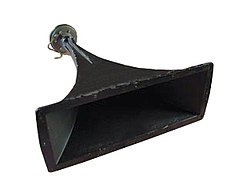
A midrange horn driver used in dwelling house speaker systems

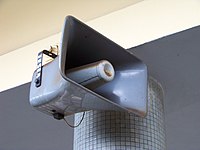
A horn loudspeaker is a loudspeaker or loudspeaker chemical element which uses an acoustic horn to increase the overall efficiency of the driving element(s). A common form (right) consists of a compression driver which produces sound waves with a small-scale metal diaphragm vibrated by an electromagnet, attached to a horn, a flaring duct to conduct the sound waves to the open air. Another type is a woofer driver mounted in a loudspeaker enclosure which is divided by internal partitions to grade a zigzag flaring duct which functions equally a horn; this type is called a folded horn speaker. The horn serves to improve the coupling efficiency between the speaker driver and the air. The horn can exist thought of equally an "acoustic transformer" that provides impedance matching betwixt the relatively dense diaphragm cloth and the less-dense air. The upshot is greater acoustic output power from a given driver.[1]
The narrow part of the horn next to the driver is called the "throat" and the large part farthest away from the driver is called the "oral cavity".[i] The angular coverage (radiation pattern) of the horn is adamant past the shape and flare of the oral cavity. A major problem of horn speakers is that the radiation pattern varies with frequency; loftier frequency sound tends to be emitted in narrow beams with poor off-axis performance.[2] Significant improvements take been made, starting time with the "constant directivity" horn invented in 1975 by Don Keele.
The main advantage of horn loudspeakers is they are more efficient; they can typically produce approximately iii times (ten dB)[3] [4] [5] more sound power than a cone speaker from a given amplifier output. Therefore, horns are widely used in public address systems, megaphones, and audio systems for large venues like theaters, auditoriums, and sports stadiums. Their disadvantage is that their frequency response is more than uneven because of resonance peaks, and horns have a cutoff frequency below which their response drops off. (The cutoff frequency corresponds to the wavelength equal to the circumference of the horn mouth.[6]) To achieve acceptable response at bass frequencies horn speakers must be very large and cumbersome, and so they are more than often used for midrange and high frequencies. The outset practical loudspeakers, introduced effectually the plough of the 20th century, were horn speakers. Due to the development in recent decades of cone loudspeakers which sometimes accept a flatter frequency response, and the availability of inexpensive amplifier power, the use of horn speakers in loftier fidelity sound systems over the last decades has declined.
Performance [edit]

Various horn prototypes in the lab of Theo Wangemann, Thomas Edison'south chief horn designer. From about 1888 to 1925, a horn was used to concentrate sound waves in the process of recording onto Edison cylinders, and another horn was used to dilate the recordings during playback.
An acoustic horn converts large pressure level variations with a small deportation area into a low force per unit area variation with a large displacement surface area and vice versa. It does this through the gradual, oft exponential increment of the cantankerous exclusive area of the horn. The modest cross-sectional surface area of the throat restricts the passage of air thus presenting a loftier acoustic impedance to the commuter. This allows the commuter to develop a high pressure for a given displacement. Therefore, the sound waves at the throat are of high pressure level and low displacement. The tapered shape of the horn allows the audio waves to gradually decompress and increase in deportation until they reach the oral fissure where they are of a low pressure but large deportation.[7]
Technology history [edit]

Francis Barraud's original painting of Nipper looking into an Edison Bell cylinder phonograph
The physics (and mathematics) of horn operation were developed for many years, reaching considerable sophistication before WWII. The virtually well known early horn loudspeakers were those on mechanical phonographs, where the record moved a heavy metal needle that excited vibrations in a pocket-size metal diaphragm that acted equally the driver for a horn. A famous example was the horn through which Nipper the RCA dog heard "His Master's Voice". The horn improves the loading and thus gets a improve "coupling" of energy from the diaphragm into the air, and the pressure variations therefore get smaller as the book expands and the sound travels upwards the horn. This kind of mechanical impedance matching was absolutely necessary in the days of pre-electrical audio reproduction in order to achieve a usable sound level.[eight]
Megaphone [edit]

A collapsible cone horn with removable flared bell. This horn was patented in 1901 for gramophone record playback.
The megaphone, a simple cone fabricated of newspaper or other flexible textile, is the oldest and simplest audio-visual horn, used prior to loudspeakers as a passive audio-visual amplifier for mechanical phonographs and for the human vox; it is nonetheless used by cheerleaders and lifeguards. Considering the conic section shape describes a portion of a perfect sphere of radiated sound, cones have no stage or amplitude distortion of the wavefront.[2] The small-scale megaphones used in phonographs and as loudhailers were not long enough to reproduce the low frequencies in music; they had a high cutoff frequency which attenuated the lesser two octaves of the sound spectrum, giving the megaphone a characteristic tinny sound.[2]
Exponential [edit]
A iii-way Klipsch loudspeaker from the late 1970s employing a different exponential horn at each bandpass[nine]
The exponential horn has an acoustic loading property that allows the speaker driver to remain evenly balanced in output level over its frequency range. The benefits of the blueprint were first published by C.R. Hanna and J. Slepian in 1924 for the American Institute of Electrical Engineers (AIEE).[ten] A major drawback is that the exponential horn allows for a narrowing of the radiation design every bit frequency increases, making for high frequency 'beaming' on axis and boring sound off axis.[ii] Another concern is that a throat of small diameter is needed for high efficiency at high frequencies but a larger throat is best for depression frequencies. A common solution is to use two or more horns, each with the appropriate throat size, mouth size and flare rate for all-time functioning in a selected frequency range, with sufficient overlap between the frequency ranges to provide a smoothen transition between horns. Some other solution tried in the late 1930s past Harry F. Olson of RCA was to use multiple exponential flare rates, either by connecting increasingly larger horns in series or by subdividing the interior of a unmarried horn.[11] Exponential horns continue to be used by some designers, and in some applications.[12]
Multicell [edit]

Altec multicell horn models from a 1978 product catalog
A number of symmetrical, narrow dispersion, usually exponential horns can exist combined in an array driven by a single commuter to produce multicell horns. Patented in 1936 by Edward C. Wente of Western Electric,[13] multicell horns have been used in loudspeakers since 1933 to address the problem of directivity at higher frequencies, and they provide first-class low frequency loading. Their directional control begins to beam both vertically and horizontally in the centre of their target frequency range, narrowing further at high frequencies[2] with level changes equally great equally x dB between lobes.[14] Multicell horns are circuitous and difficult to fabricate and thus have a higher associated expense. They persisted in public address applications for many years because, even with their faults, they sounded very skillful, and withal do with competent pattern.[15] The revolutionary coaxial commuter, the Altec Lansing Duplex 601 and 604, used a multicell horn for its high frequency component from 1943 to 1998.[16]
Radial, sectoral, and diffraction [edit]

A JBL model 2397 diffraction horn from 1978. The 2397 contained internal sectoral vanes which divided the pharynx into vi exponential sections.
Radial horns have two surfaces based on an exponential flare rate, and 2 straight walls that determine the output pattern. The radial horn exhibits some of the beaming of the exponential horn.[2] Altec sectoral horns were radial horns with vanes placed in the mouth of the horn for the stated purpose of design control. For ease in mounting to loudspeaker cabinets, apartment front radial horns accept been used, for instance by Community in their SQ 90 loftier-frequency horn.[17] JBL's diffraction or "Smith" horn was a variation on the radial design, using a very small vertical dimension at the mouth every bit a method of avoiding the mid-range horizontal beaming of radial horns that have a larger vertical dimension at the mouth.
The diffraction horn has been popular in monitor designs and for near-field public address applications which benefit from its wide horizontal dispersion blueprint.[xiv] Counterintuitively, the narrow vertical dimension provided for an expansive vertical output pattern approaching xc° for frequencies of a wavelength equal to the narrow vertical dimension.[xv] A very modest version of the diffraction horn was designed in 1991 into the JBL model 2405H Ultra-High Frequency Transducer, yielding a 90° x 35° output pattern at twenty kHz.[18]
Tractrix [edit]
The tractrix horn is very like in many respects to the exponential horn and has gained adherents among DIY horn enthusiasts, audiophile consumers, and some manufacturers.[19] It uses a curve formula derived by assuming that a tangent to whatever point on the horn'south inner curve will accomplish the central axis of the horn with a line segment of gear up length. At the mouth, the tangent line segment becomes perpendicular to the axis and describes the radius of the mouth. This horn concept was studied past Paul One thousand.A.H. Voigt in the mid-1920s and patented in 1927.[20] The size of the tractrix horn is generated by specifying the desired low frequency "cutoff" or limit which will make up one's mind the mouth diameter.[19] 2 incremental improvements over the exponential horn include slightly better support for low frequency extension and a somewhat broader high-frequency coverage pattern.[19]
Abiding directivity [edit]

Don Keele's beginning constant directivity horn patent was assigned to Electro-Vocalisation in 1978.
In May 1975,[21] to accost problems of beamwidth irresolute at different frequencies, D. Broadus "Don" Keele, Jr. of Electro-Vox introduced a hybrid horn with an exponential expansion charge per unit about the throat followed by a conical expansion department and ending with a quickly flaring flange at the rima oris.[22] The flange at the mouth solved some remaining bug with lobing at higher frequencies.[15] Don Keele specified in ane version of his design a wider horizontal flare for design control appropriate to public accost purposes. Keele'due south paper[23] set forth the relationships between mouth size, frequency and coverage angle, providing a basis for many future developments of horn design.[15] I problem found with constant directivity horns is that the horizontal coverage pattern cannot be narrowed without making the vertical coverage pattern besides minor to be useful.[ii]
Mantaray [edit]
Subsequent to Keele'south work and using his principles, Clifford A. Henricksen and Marker S. Ureda of Altec designed a strikingly different hybrid horn displaying constant directivity traits, the horizontal diffraction or "Mantaray" horn.[24] [25] The Mantaray horn separates desired vertical coverage blueprint from horizontal, making it possible to design horns for a diversity of coverage patterns. The Mantaray shape starts with a vertically oriented JBL-style diffraction horn, leading into a conical waveguide (earliest designs), or a square or rectangular horn with four planar sides.[26] For midrange effulgent control, the outer mouth is expanded further with a brusque, flared flange in the Keele style, or with added planar sides of a greater flare angle. Low frequency efficiency is not as pronounced every bit the abiding directivity design.[24] Unlike previous designs, the apparent noon,[27] which is the focal point of design dispersion, is not the aforementioned for every frequency, making for an ellipsoidal wavefront rather than spherical. Because of this, the Mantaray can merely be arrayed satisfactorily in one aeroplane (rather than multiple planes). Its abrupt breaks in flare rate causes diffraction, reflection and baloney components.[2]
Bi-Radial [edit]
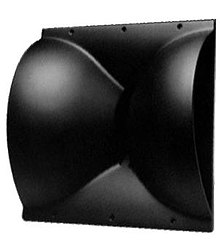
A 1996 JBL model 2344A Bi-Radial "barrel-cheeks" horn with a 100° × 100° output design from ane kHz to 12.5 kHz [28]
By 1980, Keele was at JBL where he took both his and Altec's designs a step further. He mated a JBL-style diffraction horn to a secondary horn consisting of exponentially curved sides derived by using 2 radial formulas. This resulted in a hybrid constant directivity horn that was costless from the distortion components associated with precipitous angle changes.[24] The market place responded well to the design in products such equally the JBL model 4430 studio monitor with its 100° × 100° model 2344 Bi-Radial high frequency horn ofttimes called "butt-cheeks".[29] The Bi-Radial blueprint had issues with credible apex and arrayability in the same manner as the Mantaray.[ii]
Twin Bessel [edit]
Ramsa, the professional sound sectionalization of Panasonic Corporation, introduced a twin Bessel constant directivity horn presently after the Mantaray appeared. The design was very similar to the Mantaray and the Bi-Radial only it used a dual serial Bessel expansion formula to determine the flare rate of the secondary horn section.[30]
CD horn characteristics [edit]
Most pop constant directivity horns (too known as CD horns) suffer from non-spherical wavefronts, limitations in arrayability, and distortion at high sound pressure levels as well as reflections and distortions related to the transition from diffraction slot to secondary horn.[2] They tend toward a narrowing of dispersion pattern at the higher frequencies whose wavelengths approach the width of the throat or the width of the diffraction slot.[fourteen]
Considering the CD horn's high frequencies are more than spread out over its coverage pattern, they appear attenuated relative to other horns. The CD horn requires an equalization boost of approximately 6 dB per octave[31] with a filter knee centered between ii and 4 kHz [32] (depending on horn design) in order to sound neutral and balanced. Virtually manufacturers of active electronic sound crossovers responded to this requirement by adding an optional CD EQ heave filter or high frequency shelf filter. For case, such circuitry was provided via internal jumper links past BSS in their FDS-310[33] crossover and by Rane in their Air-conditioning 22S[34] and Air conditioning 23B[35] crossovers. Rane allowed for greater front end panel control of ii bandpasses ("hi-mid" and "loftier") using CD horn equalization including sweepable frequency range on their AC 24 crossover.[36] Farther refinements of the filtering process are available in DSP-based crossovers.
Hybrid Constant Directivity (HCD) [edit]
Firstly published in December 2022 in a Voice Coil article[37] then at the 148th AES Convention[38] in June 2022, Dario Cinanni presented a new horns family.
The HCD algorithm, already used past SpeakerLAB Horn.ell.a[39] software from 2006, transforms any expansion (exponential, hyperbolic sine, hyperbolic cosine, catenoidal, tractrix, spherical, or a new expansion) horn into a constant directivity horn.
The HCD permits to maintain the same acoustic load of the original expansion. HCD algorithm reduces reflections if compared to a CD horn, or in general to a multiflare horn, providing depression distortion at high sound pressure levels.
Similar to the Radial horn HCD offers a abiding directivity on one aeroplane, to be specific a progressive constant directivity on the plane forth the horn mouth major axis. The progression depends on the selected oral fissure-ratio. While on the plane forth the oral cavity minor centrality we will accept an equivalent directivity profile of a circular mouth horn (using the same expansion).
Multiple entry horn [edit]
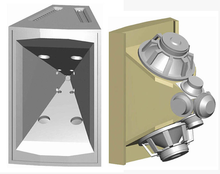
A 3-way multiple entry horn in which each passband enters the aforementioned horn
In 1996, Ralph D. Heinz of Renkus-Heinz received a patent for a multiple entry horn which incorporated multiple drivers for two bandpasses, high and mid, whose sound waves all exited into a unmarried horn but at differing distances depending on the bandpass. It was marketed as the "CoEntrant" horn.[40] The mid- and high-frequency drivers in the Renkus-Heinz ST/STX product line both exited through a "Complex Conic" waveguide.[41] In the late 1990s, Thomas J. "Tom" Danley of Sound Physics Labs began working on a 3-fashion multiple entry horn, bringing the SPL-td1 to market in 2000.[42] The pattern used seven drivers, with one high frequency driver at the horn'south throat, four mid-frequency drivers most the pharynx and ii low frequency drivers ported closer to the horn mouth. In 2001, Tom Danley began developing the "Unity" horn for Yorkville Sound, patenting the improvement in 2002.[43] Following the 2003 release of Yorkville's Unity line,[44] Danley formed Danley Sound Labs and adult a significant improvement over the SPL-td1 called the "Synergy" horn, yielding substantially better phase and magnitude response along with smoother polar blueprint. The synergy horn design promises greater power output achieved from a smaller loudspeaker enclosure.[45] Because the design retains pattern command through its crossover regions and over a big range of its total bandwidth, and because the acoustic center of the pattern is near the rear of the enclosure, information technology is more hands combined in arrays for public address applications.[46]
Waveguide horns [edit]
The term "waveguide" is used to describe horns with low audio-visual loading, such as conic, quadratic, oblate spheroidal or elliptic cylindrical horns. These are designed more than to control the radiation blueprint rather than to proceeds efficiency via improved acoustic loading. All horns accept some pattern control, and all waveguides provide a degree of acoustic loading, so the difference between a waveguide and a horn is a matter of sentence.[47]
Quadratic-Throat Waveguide [edit]
In 1999, Charlie Hughes of Peavey Electronics filed for a patent on a hybrid horn he called Quadratic-Throat Waveguide.[48] The horn was basically a simple conic section simply its pharynx was curved in a circular arc to match the desired pharynx size for proper mating to the speaker commuter. Instead of increasing the horn mouth size with a flare to control midrange beaming, a relatively sparse layer of foam covering the mouth edge was found to suit the same terminate. The QT waveguide, when compared to pop CD horns, produced well-nigh 3-4 dB lower levels of 2d harmonic distortion beyond all frequencies, and an average of 9 dB lower levels of the more abrasive third harmonic distortion. Being without a diffraction slot, the QT waveguide was costless from bug with apparent noon, making it arrayable equally needed for public address purposes.[2]
Oblate spheroid waveguide [edit]
Oblate spheroid waveguide (OSWG) horn designs ameliorate directivity blueprint control higher up 1 kHz, provide a lower frequency of directivity to better match the mid-range driver, and, equally claimed by inventor Dr. Earl Geddes, mitigate college order modes, a grade of stage and amplitude baloney. The practical limitation of horn length is explicitly not addressed by the theory of OSWG.[49]
Applications [edit]
Public address and concert use [edit]

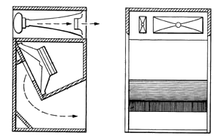
The reentrant (reflex) horn loudspeaker, or bullhorn, a type of folded horn speaker used widely in public accost systems. To reduce the size of the horn, the sound follows a zigzag path through exponentially expanding concentric ducts in the primal projection (b, c), emerging from the outer horn (d). Invented in the 1940s.
Horn loudspeakers are used in many sound applications. The drivers in horn loudspeakers can be very small, even for bass frequencies where conventional loudspeakers would need to be very large for equivalent operation. Horn loudspeakers can exist designed to reproduce a wide range of frequencies using a single, small driver; to some extent these can be designed without requiring a crossover.
Horn loudspeakers can likewise be used to provide the very high sound pressure level levels needed for sound reinforcement and public address applications, although in these high sound pressure applications, high fidelity is sometimes compromised for the sake of the necessary efficiency, and also for the controlled dispersion characteristics which are generally required in most large volume spaces. "Gunness Focusing", a new method of counteracting some of the horn distortions, especially in the time domain, was pioneered past Dave Gunness while he was with Eastern Acoustic Works (EAW). EAW horn-loaded loudspeakers that have been candy with this proprietary organization evidence reduced compression driver diaphragm/phase plug fourth dimension-smear distortion while retaining high output ability and controlled dispersion.[l] [51] [52] [53] [54]
Concert venues frequently utilize large arrays of horn loudspeakers for high-volume bass reproduction ("bass bins" or subwoofers), in society to provide bass that concertgoers tin not only hear but feel. Combining multiple horn loudspeakers in an assortment affords the same benefits as having a unmarried horn with a greater rima oris area: the low frequency cutting-off extends lower as the horn mouth gets larger, and the array has the greater output power of multiple drivers.
Commercial theaters [edit]
Commercial cinema theaters oft apply horn-loaded loudspeakers for pattern control and increased sensitivity needed to fill a large room.
Audiophiles and home utilize [edit]
Consumer sound employs horn loudspeakers for controlled directivity (to limit audio reflections from room surfaces such as walls, floor, and ceiling) and for greater speaker sensitivity.
Horn loudspeakers tin provide very loftier efficiencies, making them a good friction match for very low-powered amplifiers, such as single-ended triode amps or other tube amplifiers. After WWII, some early how-do-you-do-fi fans went so far as to build low frequency horns whose mouths took up much of a wall of the listening room. The throats were sometimes outside on the lawn, or in the basement. With the coming of stereo in the 1960s, this approach was rarely seen. Many loudspeaker buyers and practise-information technology-yourself loudspeaker fans sought smaller designs for aesthetic reasons.
Some audiophiles utilize horn loudspeakers for audio reproduction, while others eschew horn systems for their harmonic resonances, finding in them an unpleasant course of baloney. Since there are a diversity of horn designs (of differing length, textile, and taper], likewise as different drivers, it is, to some extent, impossible to give such coating characterizations to horn loudspeakers. Audiophiles using low power amplifiers, sometimes in the v to 25 watt range, may find the high efficiency of horn loudspeakers an especially attractive feature. Conversely, the loftier sensitivity can also brand any groundwork noise present at the amplifier outputs noticeably worse.
Film soundtracks take cracking dynamic range where meridian levels are 20 dB greater than average levels. The high sensitivity of horn loudspeakers aids in achieving movie theater sound levels at the listening position with typical ~100 watts-per-aqueduct receiver/amplifiers used in home cinema.[55]
See also [edit]
- French horn
- Pinch commuter
- Super tweeter
References [edit]
- ^ a b Henricksen, Loudspeakers, Enclosures, and Headphones, 446.
- ^ a b c d e f one thousand h i j k Murray, John (2000). "The Quadratic Throat Waveguide: A white newspaper on an invention past Charles E. Hughes of Peavey Electronics Corporation" (PDF). Peavey Architectural Acoustics. Archived from the original (PDF) on March 3, 2022. Retrieved April 21, 2022.
- ^ Kramer, Steven; Brownish, David Thou. (2019). Audiology: Science to Practice. Plural Publishing. p. 31. ISBN9781944883355.
- ^ Giordano, Nicholas (2010). College Physics. Cengage. p. 411. ISBN9780534424718.
- ^ Newell, Phillip; Holland, Keith (2001). Loudspeakers for music recording and reproduction. Focal Press. p. four.ane. ISBN9780240520148.
- ^ "Horn Pattern".
- ^ Kolbrek, Bjørn (2008). "Horn Theory: An Introduction". Part i, Office 2. AudioXpress magazine. Retrieved May nineteen, 2022.
- ^ US patent 1381430, Edward Phipps, "Amplifier for phonographs and the like", issued 1921-06-14
- ^ United states of america patent 4138594, Paul West. Klipsch, "Small dimension low frequency folded exponential horn loudspeaker with unitary sound path and loudspeaker system including same", issued 1979-02-05
- ^ Hanna, C. R.; Slepian, J. (September 1977) [1924]. "The Function and Design of Horns for Loudspeakers (Reprint)". Journal of the Sound Applied science Society. 25: 573–585.
- ^ Us patent 2203875, Harry F. Olson (RCA), "Loud-speaker [horn with multiple exponential flare rates]", issued 1940-06-xi
- ^ US patent 4171734, Robert S. Peveto; Phillip R. Clements (Beta Sound, Inc.), "Exponential horn speaker", issued 1979-10-23
- ^ coutant.org. Biography of Eastward.C. Wente. What Makes the Picture Talk: AT&T and the Development of Sound Move Picture Engineering science Sheldon Hochheiser, Ph.D., Corporate Historian, AT&T Labs.
- ^ a b c Eargle, JBL Audio Engineering for Sound Reinforcement, 137.
- ^ a b c d Henricksen, Loudspeakers, Enclosures, and Headphones, 454.
- ^ Audioheritage. Altec Duplex
- ^ Henricksen, Loudspeakers, Enclosures, and Headphones, 453.
- ^ JBL Professional. Publications. Discontinued product information. JBL 2405H Ultra-High Frequency Transducer
- ^ a b c Eargle, Loudspeaker Handbook, 161-164.
- ^ GB 278098 (5 Oct 1927) Paul Thou.A.H. Voigt. "Improvements in Horns for Audio-visual Instruments" [Tractrix horn]
- ^ AES Eastward-Library. What'south And then Sacred About Exponential Horns? D.B. (Don) Keele, Jr. May, 1975. 51st AES Convention.
- ^ United states patent 4071112, D. Broadus Keele, Jr. (Electro-Vocalisation), "Horn loudspeaker [constant directivity horn]", issued 1978-01-31
- ^ D. B. Keele, Jr., Electro-Vocalisation. What'due south And then Sacred About Exponential Horns? May 1975.
- ^ a b c Henricksen, Loudspeakers, Enclosures, and Headphones, 455.
- ^ Henricksen, Clifford A; Ureda, Mark South (September 1, 1978). "The Manta-Ray Horns". JAES (Journal Audio Applied science Society). 26 (9): 629–634.

- ^ United states of america patent 4187926, Clifford A. Henricksen, Mark South. Ureda (Altec), "Loudspeaker horn [Horizontal diffraction "Mantaray"]", issued 1980-02-12
- ^ Altec Lansing Engineering Notes. Technical Letter No. 262. Coverage of Multiple Mantaray Horns. Marking Ureda, Ted Uzzle. Definition of 'apparent apex' and approximate locations for a number of Mantaray horn models.
- ^ JBL 2344A Bi-Radial Horn JBL Professional Publications. Discontinued production information. (archived from hither Feb 14, 2022)
- ^ Audioheritage. JBL 4430 and 4435 Studio Monitors. David Smith. 2005
- ^ Henricksen, Loudspeakers, Enclosures, and Headphones, 455-456.
- ^ Peavey Tech Notes. Marty McCann. Abiding DIRECTIVITY HORN EQUALIZATION. (1995)
- ^ AES Pro Sound Reference. Constant directivity (CD) horn.
- ^ BSS Audio. Discontinued Products. FDS-310 Sweepable Stereo two-mode/Mono 3-mode Crossover
- ^ Rane Air-conditioning 22S Agile Crossover.
- ^ "Rane AC 23B Agile Crossover". Archived from the original on 2009-01-19. Retrieved 2008-12-31 .
- ^ Rane AC 24 Active Crossover.
- ^ "A Novel Constant Directivity Horn". audioXpress . Retrieved 2020-06-14 .
- ^ Cinanni, Dario (2020-05-28). "HYBRID CONSTANT DIRECTIVITY HORN". Audio Engineering Order.
- ^ "SpeakerLAB srl". www.speakerlab.it . Retrieved 2020-06-14 .
- ^ US patent 5526456, Ralph D. Heinz (Renkus-Heinz), "Multiple-commuter single horn loud speaker [CoEntrant horn]", issued 1996-06-11
- ^ "Renkus-Heinz. Complex Conic Wave Guide Applied science - Horns that don't sound like horns". Archived from the original on 2008-06-17. Retrieved 2008-12-29 .
- ^ "Harmony Cardinal. SPL-td1 Loudspeaker from Sound Physics Labs. March 26, 2000". Archived from the original on February 21, 2009. Retrieved Dec 30, 2008.
- ^ US patent 6411718, Thomas J. Danley (Audio Physics Labs, Inc.), "Audio reproduction employing unity summation aperture loudspeakers [Unity horn]", issued 2002-06-25
- ^ "Yorkville Sound. Unity". Archived from the original on 2008-12-21. Retrieved 2008-12-29 .
- ^ Danley Audio Labs. A White Paper on Danley Sound Labs Tapped Horn and Synergy Horn Technologies Archived 2009-02-06 at the Wayback Machine
- ^ Live Audio International. May 2006, Volume xv, Number v. TechTopic. Pat Chocolate-brown. Loudspeaker Contour: Danley Sound Labs SH-50 Archived 2008-09-sixteen at the Wayback Machine
- ^ Gunness, David (March 2005). "Decision-making Loudspeaker Coverage". Audio & Video Contractor.
- ^ US patent 6059069, Charles Emory Hughes, II (Peavey Electronics), "Loudspeaker waveguide design [Quadratic-Throat Waveguide]", issued 2000-05-09
- ^ https://www.grc.com/acoustics/an-introduction-to-horn-theory.pdf[ bare URL PDF ]
- ^ Gunness, David Westward. (Oct 2005). "Improving Loudspeaker Transient Response with Digital Point Processing" (PDF). Convention Paper. Audio Engineering Society. Archived from the original (PDF) on May 12, 2022. Retrieved January 23, 2022. Hosted past EAW.com
- ^ Evans, Jim (July 12, 2007). "EAW processing with Gunness Focusing". LSi Online.
- ^ "EAW Headlines At Bainbridge Arts Playhouse". Studio Live Blueprint. October 26, 2006.
- ^ Kridel, Tim (2007). "A Church From Scratch". Audio & Video Contractor.
- ^ Helmot, Glenn (April 9, 2006). "EAW NT Series". Audio Technology. Archived from the original on July 14, 2022.
- ^ AVS Forum List of Reference Level Speakers
Notes [edit]
- Ballou, Glen; Cliff Henricksen (1987). "Loudspeakers, Enclosures, and Headphones". Handbook for Sound Engineers: The New Audio Cyclopedia. Indianapolis, Indiana: Howard W. Sams & Co. ISBN0-672-21983-two.
- Eargle, John Thousand.; Chris Foreman (2002). "Radiating Elements". JBL Audio Engineering for Sound Reinforcement. JBL Pro Audio Publications. ISBN0-634-04355-two.
- Eargle, John M. (2003). "Horn Systems". Loudspeaker Handbook, 2nd edition. Springer. ISBN1-4020-7584-vii.
- The Quadratic Throat Waveguide: A White Newspaper On An Invention by Charles Eastward. Hughes of Peavey Electronics Corporation. (2000) John Murray, Peavey Electronics.
External links [edit]
- Lenard Audio Teaching on horn systems Illustrated guide to horn loudspeakers* The Frugal-Horns Site - open source horn projects
- Smith-Horn projects

How To Repair A Sonochorde Horn Speaker,
Source: https://en.wikipedia.org/wiki/Horn_loudspeaker
Posted by: allentiness.blogspot.com
0 Response to "How To Repair A Sonochorde Horn Speaker"
Post a Comment